Posts

Showing posts from August, 2008

Bosu- Strength Training-Series 39

Image
A fly (or flye) is a strength training exercise in which the hand and arm move through an arc while the elbow is kept at a constant angle. Flies are used to work the muscles of the upper body. Because these exercises use the arms as levers at their longest possible length, the amount of weight that can be moved is significantly less than equivalent press exercises for the same muscles (the military press and bench press for the shoulder and chest respectively). Flies can be performed using any weight that can be held in the hand. The simplest equipment to use is a dumbbell, though they can also be performed using a cable machine and sitting or standing upright. When using a cable machine, the hands and arms move through the same anatomical plane as the dumbbell version. The shoulder fly (also known as a lateral raise) works the medial deltoid muscle of the shoulder. The movement starts with the arms straight, and the hands holding weights at the sides or in front of the body. Arms ar...
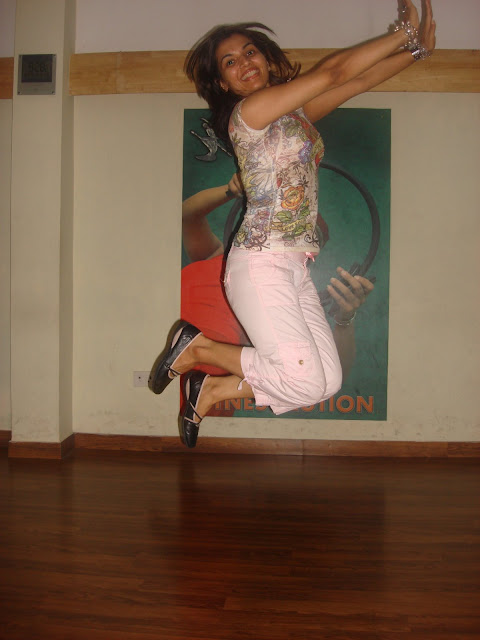
Bhangra Aerobics

Image
Try Bhangra Aerobics instead of regular aerobics. The drum beats are infectious. The steps are very ethnic and traditional punjabi. Lots of jumps and shoulder shake s makes it a very high intensity workout. You can even wear kurtis instead of lycra leotards uncomfortable tight fitted clothes and add fun element to your workout. Bhangra is the Indian rural dance from the northern state of Punjab. Bhangra is one of the trendiest of fitness and exercise routines, and is fast emerging as a popular alternative to regular aerobics winning rave reviews from the fitness gurus. Aerobics moves have hardly changed over the years and are notoriously boring. But this new fad is vivacious, dynamic and provides a break. All the moves in the programme follow the folk dance pattern, but have been reconditioned so that they can also provide a healthy cardio-vascular programme, designed to burn as many as 500 calories an hour. Since the workout is a derivative of a folk dance, ...

Bosu- Strength Training-Series 38

Image
Exercise for Posterior Deltoid Muscle The posterior deltoid is the smallest of the deltoid muscles. It is also the most important muscle to help give you the 'rounded shoulder' look. Posterior Deltoid Function The function of the posterior deltoid/shoulder muscle is for shoulder extension, transverse extension, transverse abduction and external rotation. Posterior Deltoid Origin The origin of attaches onto the inferior edge (spine) on the scapula. Posterior Deltoid Insertion The posterior deltoid muscle inserts onto the deltoid tuberosity of the humerous. Posterior Deltoid Training There are not too many exercises to train the posterior deltoid. Make sure to switch between cables and free weights to change intensities on the muscle. What if I have fatty Posterior Deltoid? What exercises can I do to reduce fat on my Posterior Deltoid Muscle? Spot reducing is a common conception to reduce the fat on a specific area. Posterior Deltoid. You cannot spot reduce, but you can: Follow s...

Bosu- Strength Training-Series 37

Image
Bicep Curl Instructions Sit on Bosu. Position two dumbbells to sides, palms facing in, arms straight. Execution With elbows to the sides, raise one dumbbell and rotate forearm until forearm is vertical and palm faces shoulder. Lower to original position and repeat with opposite arm. Continue to alternate between sides. Comments Biceps may be exercised alternating (as described), simultaneous, or in a simultaneous-alternating fashion. When elbow is fully flexed, elbow should only travel forward slightly allowing forearm to be no more than vertical to allow for a relative release of tension in muscles between repetitions. Muscles Target Biceps Brachii Synergists Brachialis Brachioradialis Stabilizers Deltoid, Anterior Trapezius, Upper Trapezius, Middle Levator Scapulae Wrist Flexors

Bosu- Strength Training-Series 36

Image
Dumbell front raises Instructions Grasp dumbbells in both hands. Execution Raise dumbbells with elbows fixed in a 10° to 30° angle throughout until upper arms are parallel to the floor. Muscles Target Deltoid, Anterior Synergists Pectoralis Major, Clavicular Deltoid, Lateral Trapezius, Middle Trapezius, Lower Serratus Anterior, Inferior Digitations Stabilizers Trapezius, Upper Levator Scapulae Wrist Extensors A variation of the above can also be done with the tubing instead of a Dumbell. Place the tubing under the Bosu and sit on Bosu. Hold each handle of the tubing in both the hands. Slowly, exhaling raise the hands up towards your shoulders. Keep the elbows soft. They should never be locked. Inhaling come down. You may do alternate hand i.e unilateral or both hands together i.e bilateral. While seated on Bosu, bend slightly forward but keep the back straight and abs tight.

Bosu- Strength Training-Series 35

Image
Dumbell Flyes Preparation Grasp two dumbbells. Lie supine on Bosu. Support dumbbells above the chest with the arms fixed in a slightly bent position. Internally rotate shoulders so elbows to the sides. Execution Lower dumbbells to sides until chest muscles are stretched with elbows fixed. Bring dumbbells together in a hugging motion until dumbbells are nearly together. Repeat. Muscles Target -Pectoralis Major, Sternal Synergists Pectoralis Major, Clavicular Deltoid, Anterior Biceps Brachii, Short Head Stabilizers Biceps Brachii Brachialis Triceps Brachii Wrist Flexors

The Headstand (Shirshasana)

Image
The Headstand (Shirshasana) This posture may look like imposing to those who haven’t attempted it. Nevertheless, it is an extremely powerful asana. It is called the "king of asanas" because of its overall effect on the whole body. For beginners, it is better to ask a friend to help you with this in the beginning. Technique Kneel down on your yoga mat. Interlock the fingers of your hands and place them and your forearms on the yoga mat. Keep the elbows fairly close together. Place the back of your head into the hollow of the palms (not on the palms or fingers). Rise up off your knees and take a step or two towards your head. Inhale, and slowly raise the legs until they are vertical. Keep your back straight and try to relax. Breathe slowly and deeply from the abdomen. Concentrate on the brain or the pineal gland between the eyebrows. To come down, bend your knees and lower one leg and then the other. Benefits The headstand increases circulation to the brain, which causes improv...

Bosu- Strength Training-Series 34

Image
1. Bench Press The bench press is a strength training exercise in which, while lying on his back on top of a Bosu, the person performing the bench press lowers a weight to the level of the chest, then pushes it back up until the arm is straight and the elbows locked (or close to this position). The exercise focuses on the development of the pectoralis major muscle as well as other supporting muscles including the anterior deltoids, serratus anterior, coracobrachialis, and the triceps. The bench press is one of the three lifts in the sport of powerlifting and is used extensively in weight training, bodybuilding and other types of fitness training to develop the chest. A starting position is to be lying on a Bosu, with the shoulder blades pinched together to avoid recruiting the anterior deltoid during the lift. Feet are kept flat on the ground or end of the Bosu. The weight is gripped with hands equidistant from the center of the bar, with the elbows bent to 90° and the elbows beneath ...

Bosu- Strength Training-Series 33

Image
1. Overhead Press Note that the correct name for the Overhead Press is Press. The Press is always done Overhead. Many say Overhead Press to avoid confusion with the Bench Press. The Bench Press is a variation of the Press, not the other way around. Sit on Bosu with abs tight and back straight. Hold the Dumbells or a barbell in hands and exhaling, take the hands up. Press the bar from your front shoulders overhead until your elbows are locked. Do 20 repetitions of 3 sets. Like with any barbell exercise, you’ll have problems finding balance the first time you try to Overhead Press. Start light, focus on your technique & add weight progressively. You’ll improve. Benefits of The Overhead Press . You can lift more weight with the Bench Press than with the Overhead Press. But the Overhead Press has many benefits over the Bench Press. Some examples: Full Body . The Overhead Press works your body as one piece. Your trunk & legs stabilize the weight while your shoulders, upper-chest ...

Bosu- Pilates-Series 32

Image
Bridging 1. Lie down on the floor or mat next to the Bosu. Keep one foot on top of Bosu with knee bent. Raise up the other leg straight up in the air. Contract your naval in towards the spine. Push your lower back towards the floor. The hamstring (back of the thigh) of the straight leg is actively getting stretched. Place both feet on top of Bosu and lift the pelvis up. Keep the naval contracted and squeeze the glutes. Keep the hands on the floor. In this position, slowly pick up your one leg off from the Bosu. The pelvis still remains lifted up. You would feel more contraction in the hamstring of the leg which is on top of the Bosu. Raise this leg straight up and hold. Repeat on the other side. The same can be done with feet on inverted Bosu. This is an advanced variation and requires more core stabilization.

Bosu- Pilates-Series 31

Image
1. DOUBLE LEG STRETCH Lie on Bosu on the back with both knees bent and feet off the floor. Place the hands behind the head. Float the head off the Bosu. Practice 3 sets of breath with hollowing. Feel the belly deflate with the hollow. Lower leg demands more abdominal control. If you feel the back, bring the leg higher or return to beginner version. This is about the abdominals working! To start: Lie on back with both knees bent and feet off the floor. The hands are placed on each knee. Float the head off the Bosu. Exhale, hollow and extend legs and arms towards opposite walls. *(If back is working, modify the range or go back to beginner version). Inhale, and circle arms from overhead towards the extended legs. Exhale, deepen the hollow, touch hands to bent knees and flex upper spine closer to the knees. Repeat three more sets. 2. Criss Cross Lie down on Bosu. Inhale: Your upper body is in a full curve, your abs are pulling your bellybutton down to your spine, and your legs are in tab...

Bosu- Pilates-Series 30

Image
1. Hundreds Lie down on top of Bosu. Keep your legs straight up. Exhale and slowly lift your head and torso up. Raise up your hands also. Now you have to pump your hands as if bouncing the ball. Simultaneously, breathe 5 count inhale through the nose and 5 count exhale through the mouth. This makes it 10 count. Do 10 times and you would complete 100. When you exhale, pull the naval in towards the spine. This works on transverse abdominus muscle. Excellent exercise for core conditioning. The hundred is a classic Pilates exercise. The hundred is often used as a dynamic warm-up for the abdominals and lungs. It requires that you coordinate your breath with the movement, and be strong and graceful at the same time. It is challenging. Take five short breaths in and five short breaths out (like sniffing in and puffing out). While doing so, move your arms in a controlled up and down manner - a small pumping of the arms. Be sure to keep your shoulders and neck relaxed. It is the abdomi...

Bosu- Yoga for lats and obliques-Series 29

Image
1. Triyakatadasana or standing half wheel Stand with feet apart. One foot on top of Bosu. Raise your hands up overhead. Grip one wrist with the other hand and bend to the side. Hold for 30 seconds and repeat on the other side. Benefits: Stretches arms and the lats. Makes spine more flexible. Caution: Do not attempt if you have frozen shoulder or severe back problem. 2. Parigharasana or sitting side stretch Kneel down and place the right knee on top of the Bosu. Extend left leg straight out to side on the floor. The toe of the left leg should be pointing outward. Raise your right hand up and take it overhead to the left side while placing the left hand on your waist. Hold and repeat on the other side. Benefits: Stretches the muscles of pelvic region, trunk arms and thighs. Strengthens the back muscles. Caution: Do not attempt if you have back problem. 3. Uthitatrikonasana or The Extended Triangle Stand with feet wide apart. Place right foot on top of Bosu and turn it outward.Raise your...

Bosu- Yoga for lats and obliques-Series 28

Image
1. Ardha Chakrasana or the half wheel Stand on straight on top of Bosu. inhale and slowly raise your one hand out to the side, parallel to the floor. Then take your arm upwards over your head so that the ear touches the shoulder. Exhale and bend to the side and even tilt your head to the side.Hold for 10-30 seconds and repeat on te other side. Benefits: Tones latissimus dorsi. Helps in curing asthma because the functional capacity of lungs is enhanced and you improve your breathing. Caution: Do not hold your breath. Do not bend backwards. 2. Trikonasana or The Triangle Stand next to Bosu with your feet apart. Slowly place one foot on top of Bosu. Bend sideways and slide your hand down towards the foot which is on top. Hold and repeat on the other side. Benefits: Tones abductors, lats and obliques Caution: Do not attempt if you have high blood pressure, vertigo or severe back problem. 3. Hasta Kona Trikonasana or the tilted Triangle Standing position is similar to the above. Slowly plac...

Bosu- Yoga for Hips-Series 27

Image
1. Hastha Padasana Stand on top of Bosu with your feet together. Exhale and bend forward from the waist to touch your knees with your forehead. tailbone should be up, knees straight and take the hands towards the feet. Hold for 10-30 seconds. Benefits: Tones abdomen. Stretches hamstrings. Because of forward bending posture, increases the blood flow towards the head. Thus improves metabolism, concentration and vitality. Caution: Do not attempt if you have high blood pressure. Bending forward may cause sudden rush of blood flow towards head. Do not attempt if you have back problems. 2. Bakasana or The Crane Pose Stand straight. Slowly bend forward from the waist and rest your hands on top of the Bosu under your shoulders and look down. Raise one leg off from the floor and bring it high up, parallel to the floor, behind you, while keeping the other foot on the floor. Now slowly lift the back heel off from the floor too and push the body weight further ahead. Benefits: Strengthens and incr...

Bosu- Yoga for Legs-Series 26

Image
1. Natarajasana Stand on top of Bosu with feet apart. Bend your knees and keep the back straight. Stretch your arms straight above your head. Benefits: Strengthens the thigh, calf and ankle joints. Tones Abductors. Improves posture. Caution: Do not attempt if you have stiff knees and ankles or weak back. 2. Vatayasana or Arched Moon Pose Stand on top of Bosu. Slowly pick up left one foot and grab it with left hand. The right hand goes up overhead. The left knee is bent. Feel the stretch in your quadriceps. Straighten up the left hand which is grabbling the foot in a manner that a triangle is made between your back, arm and leg. Slowly bend your torso forward and lower your right arm in front of you till it is parallel to the floor. Balance the body on the right leg, still holding your left foot with your left hand. To improve your balance, constantly keep looking at one point. This also helps to improve concentration besides improving your balance. Hold and repeat on the other side. B...

Bosu- Yoga for Legs-Series 25

Image
1. Vajrasana Sit in Vajrasana on top of Bosu. This is kneeling position as shown below with your buttocks under your heels. 2. Supta Vajrasana or The reclining Hero Sit in vajrasana on the floor and slowly bend backwards taking support of Bosu behind your back. Rest your head on Bosu. Grab hold of your ankles with your hands. Benefits: Strengthens and improves the flexibility of ankles and knees. Stretches the quadriceps i.e the front of thigh. Improves the back posture and curvature of spine. Caution: Do not attempt if you have week back, neck or stiff knees.